From Asking Questions to Building Things
Looking back at my first ChatGPT conversations, I found a question from 2023 that I'm still working on, with a few more tools and a lot more questions.
I’ve been thinking lately about how much the way I use AI has changed, so I went back and found my first ChatGPT conversations.
My second conversation, from July 27, 2023, started with the question, “How do you say cat farted in French?”
From there, I asked whether “ChatGPT” and “cat farted” sounded the same in French, whether Zillow would ever try to buy the moon, and somehow ended up in a fairly serious discussion about the ethics of exploiting celestial resources. I asked whether ChatGPT’s knowledge expanded through our conversations, told it its fly was down, asked whether it ever got any downtime, and finished by asking whether it was related to C-3PO.
I laughed reading it again. I clearly had no idea what I was doing. I was curious about the technology and was mostly poking at it to see what it could do, where its boundaries were, and how it would respond.
My first conversation, two days earlier, was even more interesting to me in hindsight.
In that one thread, I asked about property ownership, had ChatGPT draft a letter, asked about foraging, requested several ridiculous songs, and threw a few strange hypotheticals at it. I also asked this:
“How can I create a program to pull data from the property appraiser website?”
That was July 25, 2023.
As I write this in October 2026, that’s essentially what I’m building.
What began as an idea I didn’t have the technical ability to implement has evolved into a much larger project. I now have a Linux server collecting and processing property and public data, Python scripts handling data ingestion and automated refreshes, SQLite databases combining multiple data sources, SQL queries helping me explore and evaluate that information, and an API beginning to make the data usable by other tools. The longer-term goal is a self-hosted underwriting, property intelligence, and prospecting platform built around the way I actually work.
Earlier this month, I also started using Codex against that codebase for the first time. That’s very new territory for me, and I’m curious to see where it leads.
The path between those two points hasn’t been a deliberate effort to become a programmer or an AI expert. Most of it has been driven by problems I wanted to solve or ideas I wanted to explore.
I tend to learn best that way. I can read about something and understand it conceptually, but I learn much more when I have a reason to actually use it. I go through the motions first, ask a lot of questions, make mistakes, figure out why something didn’t work, and eventually begin to understand what I’m doing and why.
Over the last few years, that process has taken me into areas I wouldn’t have expected: more sophisticated spreadsheets and analytical tools, workflow design, automation, APIs, n8n, OAuth, Linux, databases, SQL, Python, and now Codex. I’m not an expert in any of these things, but what has changed considerably is my ability to work with them, understand them well enough to solve real problems, and keep learning when I reach the edge of what I know.
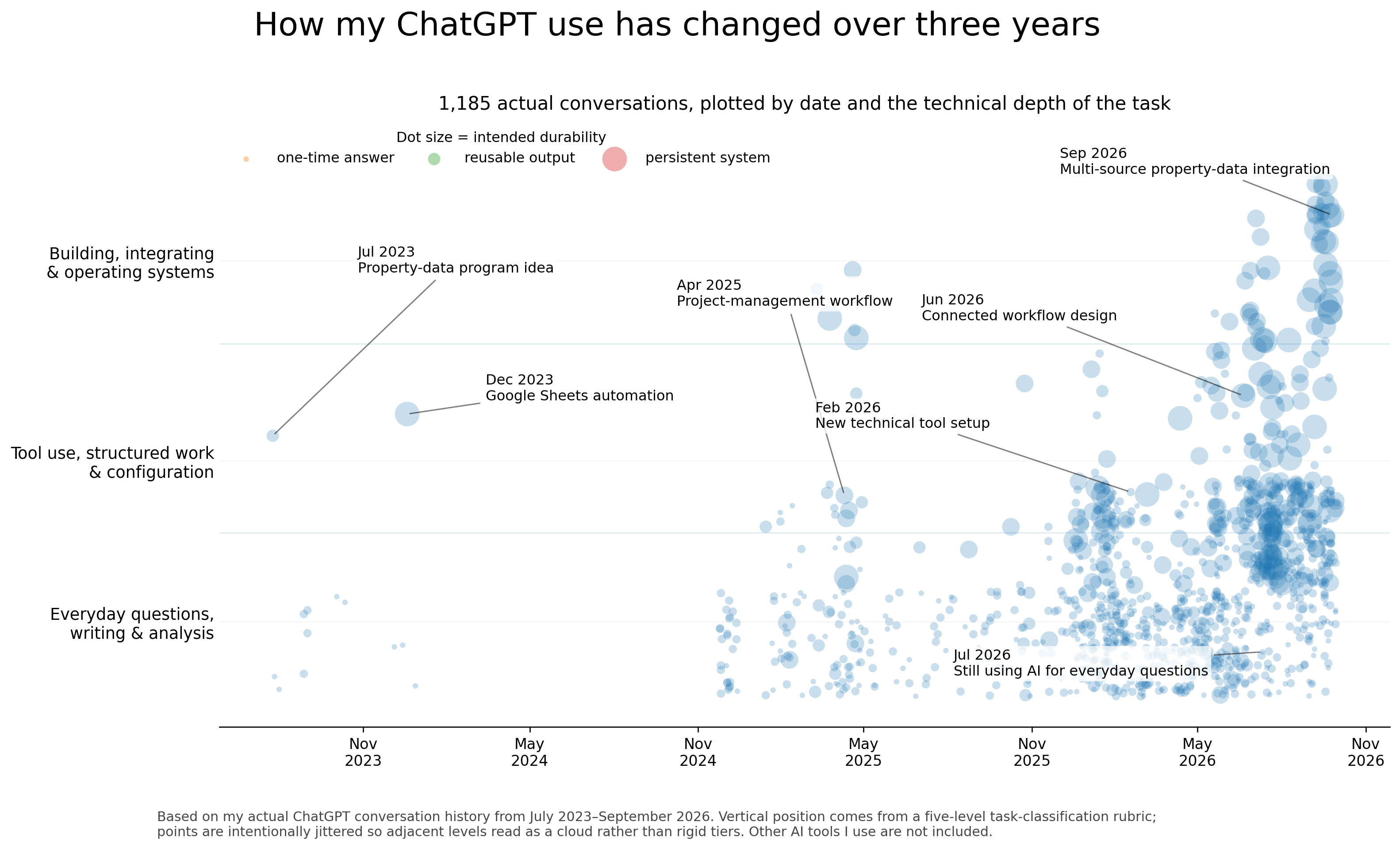
I’ve sometimes described AI as feeling like an Iron Man suit. It allows me to attempt things that would have been well beyond my practical reach a few years ago, while still requiring me to decide what I’m trying to accomplish, provide direction and context, evaluate the results, troubleshoot problems, and gradually learn more about the systems underneath it.
I’m also struck by how accessible much of this capability has been. For around $20 a month, I’ve had access to tools that have helped me learn and build things that not long ago would have required specialized skills, expensive software, outside help, or some combination of all three.
I don’t know where that goes from here. The tools will change, the economics may change, and I’m sure the way I use them will change too. One thing I’ve become increasingly interested in is using the access I have now to create things that last beyond an individual AI conversation: code, systems, workflows, documentation, data, tools, and, probably most importantly, skills I didn’t have before.
Looking back at those first conversations also makes me appreciate the value of simple curiosity. There was no roadmap connecting “How do you say cat farted in French?” to building a property-data platform three years later.
There still isn’t much of a roadmap.
But apparently I’ve been curious about some of the same problems all along.